One Earth, One Future
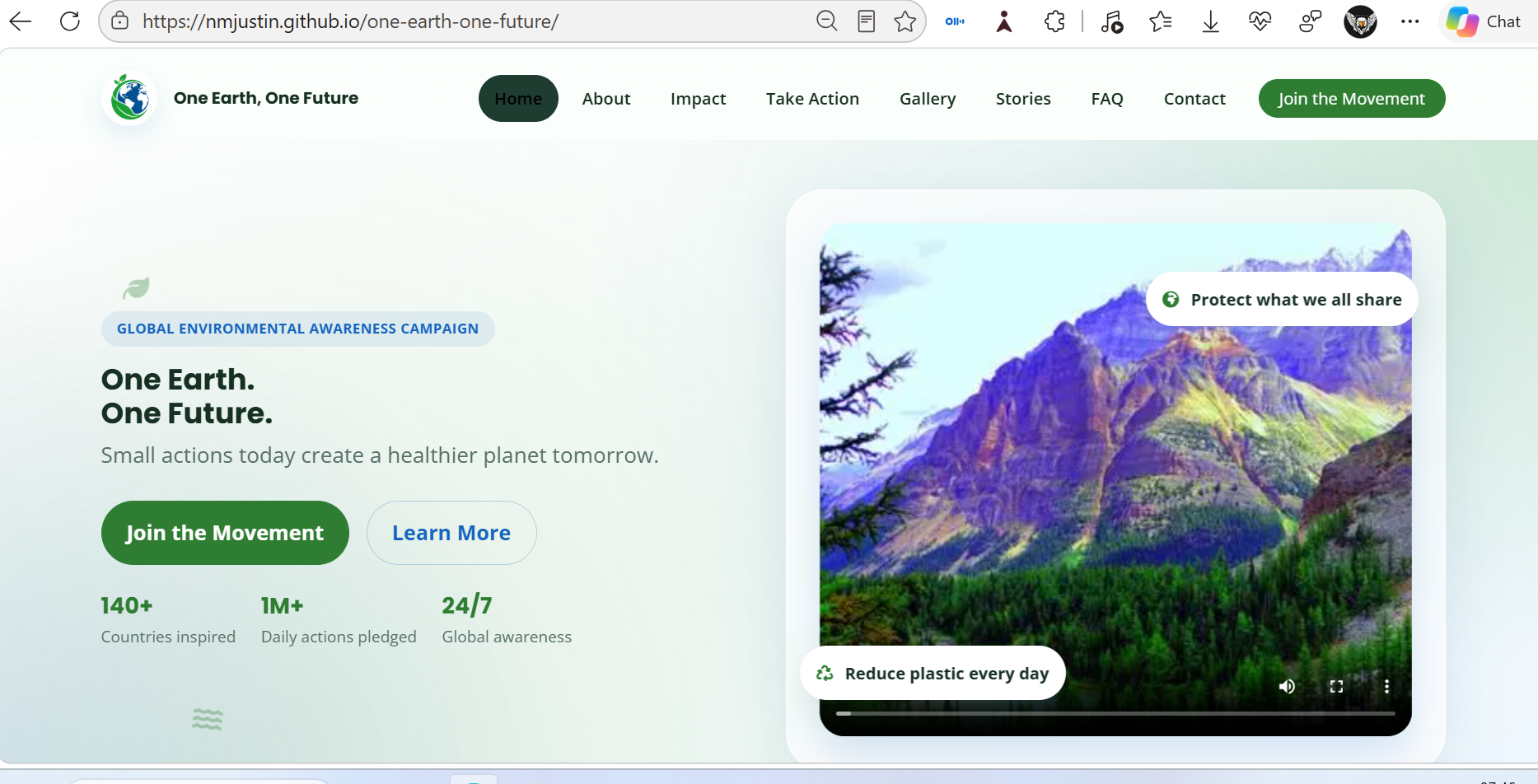
A responsive environmental awareness website with multiple sections — impact, take action, gallery, stories, FAQ and contact — built to practise layout, navigation and content structure.

Information Technology Student · Software Developer · AI Enthusiast
Turning ideas into digital solutions
I am a third-year Bachelor of Information Technology student at the University of Rwanda (expected graduation 2027), with a foundation in software development, databases, artificial intelligence and problem solving. I learn by building: academic projects, personal experiments and AI-assisted work that turn ideas into structured, testable solutions.
About me
My portfolio shows growth, not only polished results. Each project taught me something I carried into the next one.
Third-year Bachelor of Science in Information Technology student at the University of Rwanda, currently in Year 3 of 4.
My experience comes from academic and personal projects involving programming, web development, SQL databases and AI prompt engineering.
I am recognised for leadership, teamwork and the ability to transform ideas into structured, testable solutions.
Learning journey
From first lines of code to AI-assisted problem solving — each step is still in progress, and that is the point.
Learning to think in code with Python, Java, PHP, JavaScript and C# — starting from coursework exercises and moving towards small working programs.
Building responsive pages with HTML, CSS and JavaScript, and connecting them to data so a page becomes a usable product.
Designing SQL databases and writing queries, then using that data to answer questions instead of only storing it.
Prompt design, AI workflow integration, automation concepts and AI-assisted research — tested through my own prototypes.
Breaking large tasks into smaller testable steps, debugging patiently, and documenting what worked and what did not.
Trying ideas that may not be perfect yet: experiments, iterations and rebuilds are part of how I grow.
Projects
Live work, academic projects and work in progress. New projects can be added at any time.

A responsive environmental awareness website with multiple sections — impact, take action, gallery, stories, FAQ and contact — built to practise layout, navigation and content structure.

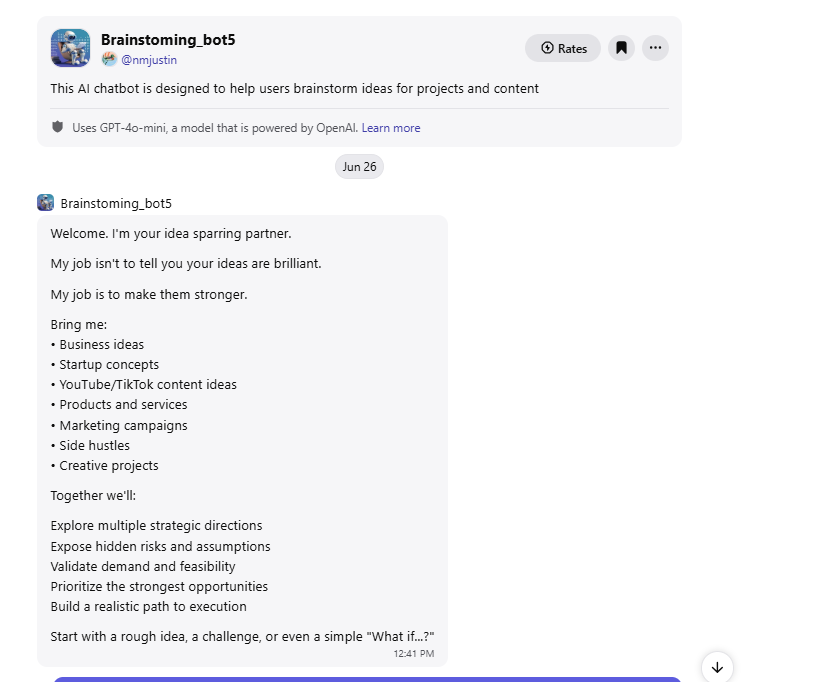
An AI chatbot I designed on Poe to help users brainstorm ideas for projects and content. It challenges an idea, exposes risks and assumptions, and helps shape a realistic path to execution.
My data analysis practice project: taking a raw dataset, cleaning it, querying it with SQL and turning the result into a dashboard that answers a question instead of only displaying numbers.
Collaborated with a development team to build a Java-based inventory system featuring database integration and data management functionality.
Designed and developed a responsive website using HTML, CSS and JavaScript with SQL database integration for user data management.
AI & creative experiments
I treat AI as a collaborator I have to supervise: useful for speed and exploration, never a substitute for understanding.
Using AI to explain unfamiliar code, suggest alternatives and speed up debugging — while I stay responsible for reading, testing and understanding the result.
My Brainstorming Chatbot is the clearest example: a prompt-designed partner that pressure-tests ideas instead of just agreeing with them.
Asking better questions of data, drafting SQL queries and interpreting results, then verifying the numbers myself.
Rapid, exploratory building to test whether an idea feels right before investing in a structured version of it.
Prototypes and workflow automations that may not be finished products, but that teach me something worth keeping.
Prompt engineering
Two real prompts of mine with the same goal. The difference is not the wording — it is the context, constraints and required output.
I want you to tell me how can I improve my learning jurney
No role, no context, no constraints and no definition of success. The answer can only be generic advice that fits anyone, so it helps no one.
Act as an academic coach, productivity strategist and technology-learning mentor. Help me improve and organize my learning journey as a university Information Technology student. I wake up at 6:00 AM and spend about 1 hour commuting to university. I am currently balancing: - University academics — classes, assignments, exams and revision. - Online courses — developing additional technical and professional skills. - Personal projects — applying what I learn through practical projects and building my portfolio. My goal is to become a strong, practical technology professional with skills in programming, data analysis, web development, AI, problem-solving, creativity and innovation. I want to learn deeply, not just collect certificates, and I want to use AI as a learning assistant without becoming dependent on it. Analyze my situation and create a realistic learning system that helps me: 1. Balance academics, online courses and projects. 2. Prioritize what I should focus on and avoid doing too many things at once. 3. Use my commuting time effectively. 4. Create a practical daily and weekly routine while maintaining enough rest and sleep. 5. Follow a Learn → Practice → Build → Reflect → Improve learning cycle. 6. Use AI responsibly while maintaining my own thinking and problem-solving skills. 7. Track my progress and improve continuously. Finally, give me my top priorities, a weekly schedule, a simple 6-month roadmap and the biggest mistakes I should avoid. Keep the plan realistic and challenge me if my expectations are too ambitious.
Gives a role, my real constraints (wake-up time, commute, three competing workloads), an explicit goal, a numbered list of what to solve, the required output format — and permission to push back on me.
Skills
Listed honestly: strongest first, with the areas I am actively learning marked as such.
Responsible AI
These rules keep my work trustworthy for lecturers, recruiters and anyone reading it.
AI output is a draft, not a source. I verify claims, numbers and code before using them.
I avoid sharing personal or confidential data with AI tools.
I only publish work, screenshots and information I have the right to share.
Ideas and writing stay mine; AI assists the process, it does not replace the thinking.
I follow university expectations and disclose where AI assisted my work.
The final decision — what to keep, fix or discard — is always mine.
Education & certifications
Bachelor of Science in Information Technology — Year 3 of 4 (expected graduation 2027)
Mathematics, Computer Science and Economics (MCE)
Ordinary Level Education
Ethical Hacker
2026Cisco Networking Academy
Student-level credential covering ethical hacking methodology, penetration testing documentation, information gathering and vulnerability scanning, social engineering, wired/wireless and application exploitation, cloud, mobile and IoT vulnerabilities, post-exploitation activities and pentest reporting. Issued 27 January 2026.
View certificate (PDF) →Contact
Open to internships, collaborations and student projects. Send a message below and it lands straight in my inbox.